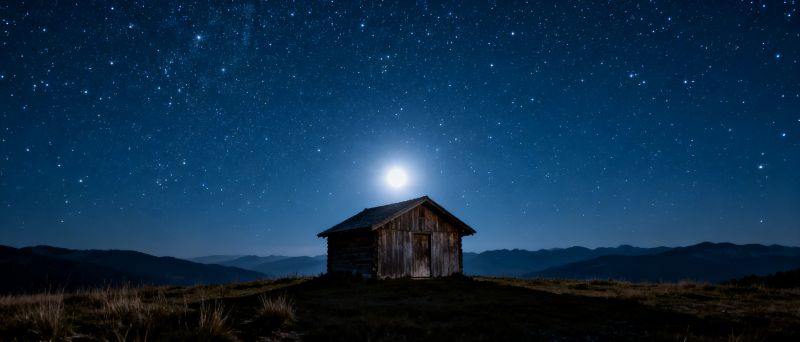
ast winter, I spent a week in a cabin with no cell service. The nearest town was eleven miles away—far enough that the silence felt physical. By day three。I noticed something odd: I could hear my own thoughts without them being interrupted by notifications. That distance, both literal and figurative, recalibrated my attention. It made me wonder whether we've lost something essential by collapsing every far into near.We tend to treat far as a problem to solve. Faster planes, instant messages, same-day delivery—all technologies of proximity. But far isn't just a gap to close. It's a condition that shapes behavior. Consider the farmer who plants a tree knowing he'll never sit in its shade. That far horizon—decades, not days—changes how he waters, prunes。and plans. Remove the far, and you get quarterly thinking, short-term fixes, the relentless now. I've seen it in offices where every decision is optimized for the next earnings call. The far gets sacrificed, and nobody notices until the roots are shallow.
In ecology, far matters too. A forest fragment isolated by miles of farmland behaves differently than one connected by a corridor. Species that need to roam—bears, cougars, certain warblers—fade when the far becomes too far to cross. Conservationists call it fragmentation. I call it the cost of forgetting that distance is a habitat feature。not an inconvenience. The same logic applies to human relationships. A friend who moves far away isn't lost;the relationship shifts to letters, occasional calls, the slow accumulation of shared history across time zones. That farness can deepen intimacy rather than erode it, if you let it.Language carries the tension. "So far, so good" acknowledges a limit without panic. "Far from perfect" admits imperfection while implying a direction. We use far to measure everything from progress to eyesight, and in each case it implies a reference point—a here, a now, a standard. The far is never absolute. It's always relative to where you stand. That relativity is useful. It reminds you that your vantage point isn't the only one. I've found that the most stubborn disagreements often dissolve when someone says, "That's far from what I see." It's an invitation to trade places。not a dismissal.
Maybe the real value of far is that it forces patience. You can't rush a mountain. You can't shortcut a long friendship. You can't compress a decade of soil regeneration into a season. The far asks you to hold a thought without immediate reward。to trust processes you can't fully see. In a culture that worships the near—the instant, the trending, the optimized—that's a radical stance. So the next time you encounter something far—a goal, a person, a landscape—resist the urge to close the gap. Sit with it. Let the distance do its work. You might find that far isn't a barrier. It's a teacher.